
Biogeographic patterns of Pacific white-sided dolphins based on long-term passive acoustic records.
Diversity and Distributions. 2024.
30:e13903
More details
Collapse details
Date Published:
Publication:Ocean:Species:Methods:
- June 24, 2024
This study investigates the biogeographic patterns of Pacific white-sided dolphins (Lagenorhynchus obliquidens) in the Eastern North Pacific based on long-term passive acoustic records. We aim to elucidate the ecological and behavioural significance of distinct echolocation click types and their implications for population delineation, geographic distribution, environmental adaptation and management.
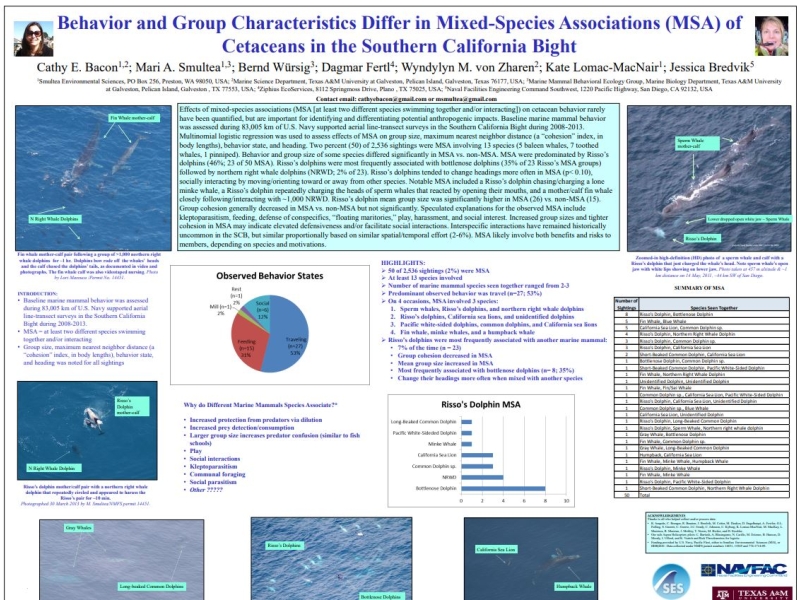
Mixed-species associations seen in the Southern California Bight during aerial surveys 2008-2012.
Southern California Marine Mammal Workshop 2013 .
More details
Collapse details
Date Published:
Filesize:
- February 1, 2013
Fifteen aerial surveys (72,647 km) occurred during 2008-2012 to monitor occurrence, abundance, and behavior of marine mammals in the Southern California Bight (SCB) on behalf of the U.S. Navy. Thirty-six (2%) of 2,151 total sightings of at least 11 species were mixed-species associations (i.e., at least two different species swimming together/interacting). Little is known about these associations. Risso’s dolphins were most frequently associated with another marine mammal species (19 [7%] of 238 total Risso’s sightings) as follows: with sperm whales (1x), California sea lions (CaSL) (3x), and bottlenose (7x), northern right whale (NRWD) (4x), long-beaked common (1x), unidentified (1x), and common dolphin sp. (2x). Up to 3 species occurred together on 3 different occasions: (1) sperm whales/Risso’s/NRW dolphins, (2) Risso’s/unidentified dolphins/CaSL, and (3) Pacific white-sided/common dolphins with CaSL. The most unusual mixed species sighting was 24 sperm whales (including 4 calves) with 11 Risso’s and ~50 NRW dolphins: Risso’s repeatedly charged adult sperm whales’ heads who responded by dropping their lower jaw, perhaps related to kleptoparasitism. Potential reasons for mixed-species associations include increased protection from predators via dilution, increased prey detection/consumption, and “play” (i.e., fin whale calf touching NRWD). Data include interactions not previously documented in the SCB among these socially complex animal groups.
- 2,082.37 KB
Mixed-species associations of marine mammals in the Southern California Bight, with emphasis on Risso’s dolphins (Grampus griseus).
Aquatic Mammals. 2017.
43:177-184
More details
Collapse details
Date Published:
Publication:Ocean:Region:Species:Methods:
- January 1, 2017
This study investigates mixed-species associations among marine mammals in the Southern California Bight, focusing specifically on Risso's dolphins (Grampus griseus). Over a six-year period, aerial surveys were conducted to record the frequency and nature of these associations, revealing that Risso's dolphins were the most commonly observed species in mixed interactions. The results indicate a significant decline in the proportion of Risso's dolphins involved in such associations compared to historical records, possibly due to an increase in their relative abundance. The findings underline the importance of monitoring mixed-species associations to understand marine mammal dynamics and ecological interactions.
More details
Collapse details
Date Published:
Filesize:
- December 1, 2020
The overall goal of this study was to include the 2018 survey data in the previous 1991–2014 modeling dataset in order to improve SMDs for the CCE study area. Specific objectives included: Generating multi-year average density surfaces for the Navy and others to use in their long-term (2–7 year) environmental planning efforts; and Providing updated abundance and “minimum population size (Nmin)” estimates as defined in the Guidelines for Assessing Marine Mammal Stocks (National Oceanic and Atmospheric Administration 2016).
- 5,465.27 KB
Evaluating Seasonal vs. Spatial Extrapolation for Cetacean Distribution Models in the California Current.
Marine Mammal Science. 2025.
41(4):e70030
More details
Collapse details
Date Published:
Publication:Ocean:Region:Species:Methods:
- June 13, 2025
In this study, winter and spring density estimates for the entire CCE study area were made from SWFSC summer and fall model predictions (temporal extrapolation) and CalCOFI winter and spring model predictions (spatial extrapolation) for short-beaked common dolphin ( Delphinus delphis delphis ), Pacific white-sided dolphin ( Lagenorhynchus obliquidens ), Dall's porpoise ( Phocoenoides dalli ), and fin whale ( Balaenoptera physalus ).
More details
Collapse details
Date Published:
Filesize:
- October 24, 2014
The present study provides new and current estimates of cetacean density for the six most commonly encountered cetacean species off southern California based on sighting data collected during 37 quarterly CalCOFI cruises from 2004 to 2013. The current study resulted from a high survey repetition rate that allowed for the examination of inter-annual and seasonal trends in density as well as temporal and spatial patterns of distribution for six common cetacean species off southern California: blue whales, fin whales, humpback whales, short-beaked common dolphins, Pacific white-sided dolphins, and Dall’s porpoise.
- 4,140.75 KB
More details
Collapse details
Date Published:
Filesize:
- September 15, 2010
This report summarizes small boat based research conducted on cetaceans off southern California by the Scripps Institution of Oceanography (SIO) in collaboration with Southwest Fisheries Science Center (SWFSC) from August 2009 – July 2010. The primary objectives of this research were to use sighting, photo-identification, biopsy and acoustical sampling techniques to assess the occurrence, distribution and population structure of small cetaceans in a region that is subject to frequent naval exercises; this information is needed to evaluate possible effects from Mid Frequency Active Sonar (MFAS) trials and ultimately for the development of appropriate management protocols.
- 2,641.69 KB
More details
Collapse details
Date Published:
Filesize:
- February 1, 2014
Cetacean distribution, density and abundance in the Southern California Bight were assessed through visual and acoustic surveys during five California Cooperative Oceanic Fisheries Investigations (CalCOFI) cruises from August 2012-November 2013. Visual monitoring incorporated standard line-transect protocol during all daylight transits while acoustic monitoring employed a towed hydrophone array during transits and sonobuoys at oceanographic sampling stations. Visual effort included 584 observation hours covering 10,900 kilometers yielding 565 sightings of 15 identified cetacean species.
- 4,333.04 KB
More details
Collapse details
Date Published:
Filesize:
- December 1, 2012
Spatial and temporal distribution patterns, density and abundance of cetaceans in the southern California Bight were assessed through visual and acoustic surveys during five California Cooperative Oceanic Fisheries Investigations (CalCOFI) cruises from August 2011 – July 2012. Visual monitoring incorporated standard line-transect protocol during all daylight transits while acoustic monitoring employed a towed hydrophone array during transits and sonobuoys at oceanographic sampling stations.
- 4,929.65 KB
Inter-annual and seasonal trends in cetacean distribution, density and abundance off southern California.
Deep-Sea Research. 2015.
112: 143-157
More details
Collapse details
Date Published:
Publication:Ocean:Region:Species:Methods:
- January 1, 2015
Trends in cetacean density and distribution off southern California were assessed through visual line-transect surveys during thirty-seven California Cooperative Oceanic Fisheries Investigations (CalCOFI) cruises from July 2004–November 2013. From sightings of the six most commonly encountered cetacean species, seasonal, annual and overall density estimates were calculated. Blue whales (Balaenoptera musculus), fin whales (Balaenoptera physalus) and humpback whales (Megaptera novaeangliae) were the most frequently sighted baleen whales with overall densities of 0.91/1000km2 (CV=0.27), 2.73/1000km2 (CV=0.19), and 1.17/1000km2 (CV=0.21) respectively. Species specific density estimates, stratified by cruise, were analyzed using a generalized additive model to estimate long-term trends and correct for seasonal imbalances. Variances were estimated using a non-parametric bootstrap with one day of effort as the sampling unit. Blue whales were primarily observed during summer and fall while fin and humpback whales were observed year-round with peaks in density during summer and spring respectively. Short-beaked common dolphins (Delphinus delphis), Pacific white-sided dolphins (Lagenorhynchus obliquidens) and Dall’s porpoise (Phocoenoidesdalli) were the most frequently encountered small cetaceans with overall densities of 705.83/1000km2 (CV=0.22), 51.98/1000km2 (CV=0.27), and 21.37/1000km2 (CV=0.19) respectively. Seasonally, short-beaked common dolphins were most abundant in winter whereas Pacific white-sided dolphins and Dall’s porpoise were most abundant during spring. There were no significant long-term changes in blue whale, fin whale, humpback whale, short-beaked common dolphin or Dall’s porpoise densities while Pacific white-sided dolphins exhibited a significant decrease in density across the ten-year study. The results from this study were fundamentally consistent with earlier studies, but provide greater temporal and seasonal resolution. Keywords: Cetaceans; Line transect; Density; Abundance; Distribution; Trends; Southern California; CalCOFI
More details
Collapse details
Date Published:
Filesize:
- November 1, 2014
Passive acoustic monitoring was conducted in the Gulf of Alaska Temporary Maritime Activities Area (GATMAA) from June 2013 to May 2014 to detect marine mammal and anthropogenic sounds. High-frequency Acoustic Recording Packages (HARPs) recorded sounds between 10 Hz and 100 kHz at five locations: a shelf site offshore Kenai Peninsula (200 m depth, site CA), a continental slope site in deep water (850 m depth, site CB), a slope site offshore Kodiak Island (230 m depth, site KO), a deep offshore site at Pratt Seamount (1000 m depth, site PT), and a deep offshore site at Quinn Seamount (930 m depth, site QN).
- 15,262.96 KB
More details
Collapse details
Date Published:
Filesize:
- April 1, 2017
Cetacean distribution, density and abundance in the Southern California Bight were assessed through visual and acoustic surveys during eighteen California Cooperative Oceanic Fisheries Investigations (CalCOFI) cruises from February 2012-April 2016. Visual monitoring incorporated standard line-transect protocol during all daylight transits while acoustic monitoring employed a towed hydrophone array during transits and sonobuoys deployed at oceanographic sampling stations. Visual effort included 2,031 observation hours covering 31,807 kilometers. A total of 1,914 sightings were made, which included 18 different cetacean species. Acoustic effort included 1m027 sonobuoy deployments and 478 towed array deployments.
- 6,733.49 KB
Passive Acoustic Monitoring for Marine Mammals in the SOCAL Naval Training Area Dec 2012 – Jan 2014.
More details
Collapse details
Date Published:
Filesize:
- January 1, 2015
Passive acoustic monitoring was conducted in the Navy’s Southern California Range Complex from December 2012 to January 2014 to detect marine mammal and anthropogenic sounds. High-frequency Acoustic Recording Packages (HARPs) recorded sounds between 10 Hz and 100 kHz at three locations: near Santa Barbara Island (880 m), west of San Clemente Island (1000 m), and southwest of San Clemente Island (1300 m). Six baleen whale species were recorded: blue whales, Bryde’s whales, fin whales, gray whales, humpback whales, and minke whales.
- 21,128.75 KB
More details
Collapse details
Date Published:
Filesize:
- January 1, 2011
Navy Research Funded Year Three Project Reports
- 5,699.30 KB
More details
Collapse details
Date Published:
Filesize:
- January 24, 2013
Documenting year-round diversity and distribution of marine mammals off Southern California is important for assessment of effects of potentially harmful anthropogenic activities. Although the waters off Southern California have been surveyed extensively for marine mammals over the past 18 years, such surveys have been periodic and were conducted primarily from summer to fall, thereby missing potential seasonal shifts. We examined seasonal abundance and population density of cetaceans off Southern California from 16 shipboard line-transect surveys conducted quarterly during 2004–08. The study area consisted of 238,494 km² of coastal, shelf, and pelagic oceanic habitat from near-shore waters to 700 km offshore.
- 2,712.72 KB
More details
Collapse details
Date Published:
Filesize:
- April 1, 2022
An expedition was conducted with the goal of visually locating, acoustically recording, and obtaining biopsy samples of the Mesoplodon beaked whales that were encountered in 2020 and produce BWB pulses, as well as locating the beaked whales that produce the BW43 echolocation pulse in order to conclusively determine what species produce each of the pulse types.
- 1,398.13 KB
More details
Collapse details
Date Published:
Filesize:
- January 1, 2021
This report summarizes the field effort from 15 – 28 November, 2020, to locate and document a species of beaked whales that had previously only been acoustically detected. While the species of interest was again recorded on acoustic drift buoys, a previously undescribed species of beaked whale was unexpectedly encountered instead. This new species has external morphological characteristics and a new echolocation pulse type that do not match any previously observed or recorded species and therefore may represent a newly described species. In addition to this species of beaked whale, we encountered and photographed three species of dolphin as well as humpback whales, and recorded two other species of beaked whales on the acoustic recorders.
- 9,012.04 KB
More details
Collapse details
Date Published:
Filesize:
- July 1, 2025
Beaked whales (Family Ziphiidae; Order Cetacea) are the least well-described group of marine mammals because they conduct very long deep dives, spend little time on the surface where they display cryptic behavior, and are difficult to identify due to the similarity between species. Beaked whales are also known to be susceptible to high-energy sound sources in the ocean (e.g. seismic research, sonars used by military activities).
- 1,136.54 KB
More details
Collapse details
Date Published:
Filesize:
- September 15, 2010
This report summarizes the underwater sounds detected during a series of deployments of a High Frequency Acoustic Recording Package (HARP) in the southern California (SOCAL) offshore region. The HARP records broadband (10 Hz – 100 kHz) acoustic data, including both marine animal and anthropogenic sound. This report summarizes initial analysis to detect the presence of marine mammals by species as well as the occurrence of naval sonar and other anthropogenic sound events.
- 4,006.74 KB
More details
Collapse details
Date Published:
Filesize:
- February 1, 2018
Marine mammal surveys, initiated as part of the CalCOFI cruises in 2004, were continued during 2016-2017. Visual monitoring incorporated standard line-transect survey protocol which includes two experienced observers scanning for marine mammals during transits between CalCOFI stations.
- 1,472.91 KB
More details
Collapse details
Date Published:
Filesize:
- September 1, 2010
This report summarizes the underwater sounds detected during a series of deployments of a High Frequency Acoustic Recording Package (HARP) in the southern California (SOCAL) offshore region. The HARP records broadband (10 Hz – 100 kHz) acoustic data, including both marine animal and anthropogenic sound. This report summarizes initial analysis to detect the presence of marine mammals by species as well as the occurrence of naval sonar and other anthropogenic sound events.
- 4,006.74 KB
More details
Collapse details
Date Published:
Filesize:
- January 1, 2011
Passive acoustic monitoring was conducted at two sites in the Navy’s Southern California Range Complex during April 2010 – April 2011. These data provide information on the presence of marine mammals and anthropogenic sound sources. High‐frequency acoustic recording packages documented sounds between 10 Hz and 100 kHz with nearly continuous temporal coverage at a site near Santa Barbara Island (site M) and a site south of San Clemente Island (site N). For this reporting period, 8,099 hours of acoustic recordings were obtained from site M and 7,779 hours of recordings from site N. Data analysis methods consisted of analyst scans of long‐term spectral averages and spectrograms. The data were divided into three frequency bands and each band was analyzed for the sounds of marine mammal species or anthropogenic sources. Representative sounds are presented.
- 21,362.89 KB
More details
Collapse details
Date Published:
Filesize:
- January 1, 2012
Passive acoustic monitoring was conducted in the Navy’s Southern California Range Complex during May 2011 – March 2012 to detect the presence of marine mammal and anthropogenic sounds. Highfrequency Acoustic Recording Packages (HARPs) recorded sounds between 10 Hz and 100 kHz with nearly continuous temporal coverage at a site near Santa Barbara Island (site M) and at a site west of San Clemente Island (site H). Data analysis consisted of detection of sounds of interest by analyst scans of long-term spectral averages and spectrograms, and by automated computer algorithm detection when possible. Representative sounds are presented in this report, as well as details of the computer algorithms used to detect them.
- 37,599.29 KB
More details
Collapse details
Date Published:
Filesize:
- October 30, 2013
We conducted 18 aerial surveys in the marine waters around San Clemente Island, California, from October 2008 to July 2013, to obtain both observations of marine mammal behavior and data suitable for developing marine mammal density estimates. The primary platform used was a Partenavia P68-C or P68-OBS (glass-nosed) high-wing, twin-engine airplane. Density and abundance estimates were made using line-transect methods and the software DISTANCE 6.0.
- 2,384.70 KB
More details
Collapse details
Date Published:
Filesize:
- January 1, 2013
Passive acoustic monitoring using High-frequency Acoustic Recording Packages (HARPs) was conducted at two sites in the Navy’s Northwest Training Range Complex; one on the continental shelf near Cape Elizabeth (CE) and the other at the shelf slope near Quinault Canyon (QC). The inshore shelf site was monitored from December 2011 until January 2012, and the offshore shelf slope site was monitored from December 2011 until July 2012. In this report, information on the presence of marine mammals and anthropogenic sounds collected at these sites is presented.
- 4,259.08 KB
More details
Collapse details
Date Published:
Filesize:
- August 18, 2013
Passive acoustic monitoring was conducted in the Navy’s Southern California Range Complex during March 2012 through December 2012 to detect the presence of marine mammal and anthropogenic sounds. High-frequency Acoustic Recording Packages (HARPs) recorded sounds between 10 Hz and 100 kHz with continuous temporal coverage at a site near Santa Barbara Island (site M), at a site west of San Clemente Island (site H), and a site southwest of San Clemente Island (site N).
- 21,219.45 KB
More details
Collapse details
Date Published:
Filesize:
- November 1, 2015
A passive-acoustic glider survey was conducted in the Quinault Range Site (QRS) off the Washington coast between 11 June and 12 July 2012. This glider survey was conducted with funding from the U.S. Navy’s Office of Naval Research (ONR); awards # N00014-10-1-0515 and # N00014-08-1-1082. The survey was part of the development effort of the passive-acoustic Seaglider, which is currently being used for a marine mammal monitoring project funded by U.S. Pacific Fleet through contract N62470-10D-3011, task orders KB23 and KB25, with Naval Facilities Engineering Command (NAVFAC) Pacific. The purpose of this field trial was primarily to test the general functionality of the passive acoustic monitoring (PAM) board and a new onboard acoustic data-storage system (Revision A).
- 5,241.53 KB
More details
Collapse details
Date Published:
Filesize:
- March 1, 2016
A passive-acoustic glider survey was conducted in the Gulf of Alaska Temporary Maritime Activities Area (GoA-TMAA) between 11 July and 21 August 2015 (data collection period: 11 July through 11 August 2015). The goal of the project was to investigate the spatial distribution and temporal occurrence of odontocetes and mysticetes in the northern Gulf of Alaska. The survey focused primarily on the shelf break area between Middleton Island and Kodiak Island. The Gulf of Alaska is generally difficult to survey, and thus the knowledge about the abundance and distribution of cetaceans in this area is limited. Any additional effort improves the understanding and awareness of marine mammal occurrence in the GoA-TMAA.
- 7,691.50 KB
More details
Collapse details
Date Published:
Filesize:
- January 1, 2012
During FY2012, with funding provided by the Chief of Naval Operations (CNO) N45 Energy and Environmental Readiness Division, the Marine Mammal Monitoring on Navy Ranges (M3R) program carried out several acoustic monitoring efforts to determine the spatial and temporal distribution of cetacean species on the Southern California Anti-Submarine Warfare (ASW) Range (SOAR) , to document the reaction of these species to sonar with a focus on beaked whales, and to provide a means of longterm passive acoustic monitoring. Specifically, M3R participated in a number of marine mammal species visual verification and tagging tests, ONR-sponsored glider tests, the SOCAL 2011-12 Behavioral Response Study (BRS), and for the first time conducted low-frequency acoustic monitoring of baleen whales.
- 2,344.53 KB
More details
Collapse details
Date Published:
Filesize:
- April 1, 2009
During this project, the visual survey covered a total of 760 kilometers (410 nautical miles) on-effort while transit and fog effort legs accounted for 553 km (298 nm). There were a total of 96 sightings (453 individuals) of 11 confirmed marine mammal species; these included fin, humpback, gray, and minke whales as well as killer whales, Dall’s and harbor porpoise, Pacific white-sided dolphins and Steller sea lions, harbor seals and sea otters. Additionally, there were 36 sightings (46 individuals) of unidentified large whales, dolphins and pinnipeds. Acoustically, operations were conducted 24-hours/day surveying a total of 3,519 km (1,900 nm) and recording 49 acoustic detections of sperm whales and killer whales. Photographs of nineteen individual killer whales and four fin whales were obtained on this cruise and compared to existing catalogs.
- 1,894.30 KB
More details
Collapse details
Date Published:
Filesize:
- January 15, 2025
This document represents a brief annual summary on work completed between January 1st, 2024 to December 15th, 2024, under award N66604-22-D-F200, which is part of a broad project to monitor the populations of goose-beaked whales (Ziphius cavirostris) and fin whales (Balaenoptera physalus) in the Southern California Testing and Training Range (SCTTR).
- 2,847.52 KB
More details
Collapse details
Date Published:
Filesize:
- December 31, 2022
The Southern California (SOCAL) portion of the Hawaii-Southern California Training and Testing (HSTT) area (SOCAL TR) is one of the United States Navy’s most active training areas, particularly for mid-frequency active sonar (MFAS). Much of SOCAL lies within the Southern California Bight, a productive oceanographic region that hosts a wide variety of marine species. As part of an ongoing study of the distribution and demographics of several marine mammal species within SOCAL, we conducted 32 days of survey effort from 6 January 2022 to 26 November 2022, specifically focusing on the Southern California Anti-submarine Warfare Range (SOAR).
- 2,783.94 KB
More details
Collapse details
Date Published:
Filesize:
- August 9, 2013
The main text of this report summarizes two aerial surveys conducted in March and May 2013 during fiscal year (FY) 2013 between 01 August 2012 and 31 July 2013 on the United States (U.S.) Navy’s Southern California (SOCAL) Range Complex. In addition, a preliminary report for a third aerial survey conducted in late July 2013 is discussed separately in Appendix G of this report. This was the fifth FY in which aerial surveys were conducted to obtain baseline data on the occurrence and behavior of marine mammals in the SOCAL.
- 4,896.50 KB
More details
Collapse details
Date Published:
Filesize:
- October 1, 2010
In support of the U.S. Navy’s (Navy) Marine Mammal Monitoring Plan (M3P) in the Southern California Range Complex (SOCAL) (DoN 2009), aerial surveys were conducted by Smultea Environmental Sciences (SES) to monitor marine mammals and sea turtles (MM/ST) during November 2009 in the SOCAL area. This was the fifth such aerial survey in SOCAL conducted by SES or SES/Marine Mammal Research Consultants (MMRC).
- 9,778.80 KB
More details
Collapse details
Date Published:
Filesize:
- July 30, 2009
In support of the U.S. Navy’s (Navy) Marine Mammal Monitoring Plan (M3P) in the Southern California Range Complex (SOCAL) (DoN 2009), aerial surveys were conducted by Marine Mammal Research Consultants (MMRC) and Smultea Environmental Sciences (SES) to monitor marine mammals and sea turtles (MM/ST) during June and July 2009 in the SOCAL area.
- 4,717.48 KB
More details
Collapse details
Date Published:
Filesize:
- August 5, 2009
Aerial surveys were conducted in conjunction with two US Navy (Navy) Major Training Events (MTE) involving mid-frequency active sonar (MFAS) and explosives in October (Oct) and mid-November (Nov) 2008 in the Southern California Range Complex (SOCAL) off San Diego, California. The purpose of this survey was to monitor potential effects or lack of observable effects of MFAS and explosives on mammals and sea turtles (MM/ST) during a MTE from 17-21 Oct and beginning one day after a MTE from 15-18 Nov.
- 4,083.50 KB
Changes in Relative Occurrence of Cetaceans in the Southern California Bight: A Comparison of Recent Aerial Survey Results with Historical Data Sources.
Aquatic Mammals. 2014.
40(1):32-43
More details
Collapse details
Date Published:
Publication:Ocean:Region:Species:Methods:
- August 6, 2014
The relative occurrence of the 16 most common cetacean species in the Southern California Bight (SCB) was compared from the 1950s through 2012 by examining at-sea sighting and stranding data. While systematic survey and population abundance/density data have been available since the 1970s, prior data were collected opportunistically. Comparisons were made through a literature review and using recent results from 15 aerial surveys conducted in the SCB from 2008 through 2012. We attempted to address inconsistency in type of effort across studies by ranking the relative sighting frequency of the most common species based on the most representative study for each period. This comparison revealed changes in the relative occurrence of some species across the approximately 60-y reviewed period. Since the 1950s, common dolphins have remained the most common “species” of cetacean in the SCB. Risso’s dolphin and fin, blue, humpback, and Bryde’s whales appear to have increased in relative occurrence. The relative occurrence of the common bottlenose and northern right whale dolphins; Dall’s porpoise; and gray, killer, minke, Cuvier’s beaked, and sperm whales do not appear to have changed notably since the 1950s. There is possible indication of recent decreased relative occurrence of the Pacific white-sided dolphin. The short-finned pilot whale has decreased since the 1950s and has not been recorded in the SCB since the 1990s, concurrent with the observed relative increase in Risso’s dolphins. Overall, recent aerial surveys indicate that the 16 most commonly seen species in the SCB, in descending order of frequency, were common dolphins (two species), Risso’s dolphin, fin whale, common bottlenose dolphin, gray whale, blue whale, Pacific white-sided dolphin, humpback whale, northern right whale dolphin, common minke whale, Dall’s porpoise, killer whale, Bryde’s whale, Cuvier’s beaked whale (the latter three tied in ranking), and sperm whale. Given that the reviewed historical data from the 1950s and 1960s are virtually the only sources of information available to examine trends over the last 50 to 60 y in this area, we believe this comparative ranking approach provides useful information not available from other sources.
Behavior, group characteristics, density and habitat-use patterns of marine mammals off Southern California during 2008-2012 aerial surveys.
Southern California Marine Mammal Workshop 2013 .
More details
Collapse details
Date Published:
Filesize:
- February 1, 2013
Marine mammal seasonal density, abundance, behavior and habitat-use patterns were monitored off southern California 2008-2012 during 15 aerial surveys for the U.S. Navy. Line-transect, scan sampling, and focal follows occurred using video/photography. During 65,238 km of effort (99% Beaufort ≤4), ~190,310 individuals were seen in 2,151 groups (19+ species). Behavior differed significantly by species, depth, slope, aspect, survey sub-region (east or west of San Clemente Island (SCI)), time of year/day, and calf presence. Group size and maximum nearest-neighbor distance (in body lengths) generally increased with body size. Group size was significantly larger with calf presence for Risso’s, common, and bottlenose dolphins. Group size increased significantly across the year among Risso’s but decreased for common dolphins. Risso’s were 13x more likely to rest and significantly less likely to fast travel/be surface active than commons. Resource Selection Function analyses showed that fin whales were significantly more likely to be found west vs. east of SCI, and medium-fast travel predominated over basins vs. rest/mill/slow travel over steep slopes. Density was highest for short-beaked common dolphins followed by long-beaked commons, California sea lions, Risso’s, gray whales, bottlenose dolphins, fin, humpback and blue whales and Pacific white-sided dolphins. Calves occurred in 5% of 331 mysticete sightings.
- 1,434.36 KB
More details
Collapse details
Date Published:
Filesize:
- January 1, 2020
The CalCOFI marine mammal monitoring program examines seasonal and inter-annual patterns in density, abundance, and distribution on a longer continuous time scale and with a higher rate of sampling than previous cetacean surveys off the California coast, particularly for the winter and spring periods, for which there are currently few data available.
- 2,592.65 KB
Current
Gulf of Alaska Acoustic Moorings and Analysis
Project Objectives
Conduct systematic line transect survey for marine mammals for density estimates; conduct survey to determine ecotype identity of killer whales; analyze existing and newly collected data for seasonal occurrence, abundance, and density of cetacean
Current
Marine Mammal Sightings During CalCOFI Cruises
Project Objectives
Determine what species and populations of marine mammals are present in Southern California and estimate the abundance and density across seasonsNo related blog posts to display